
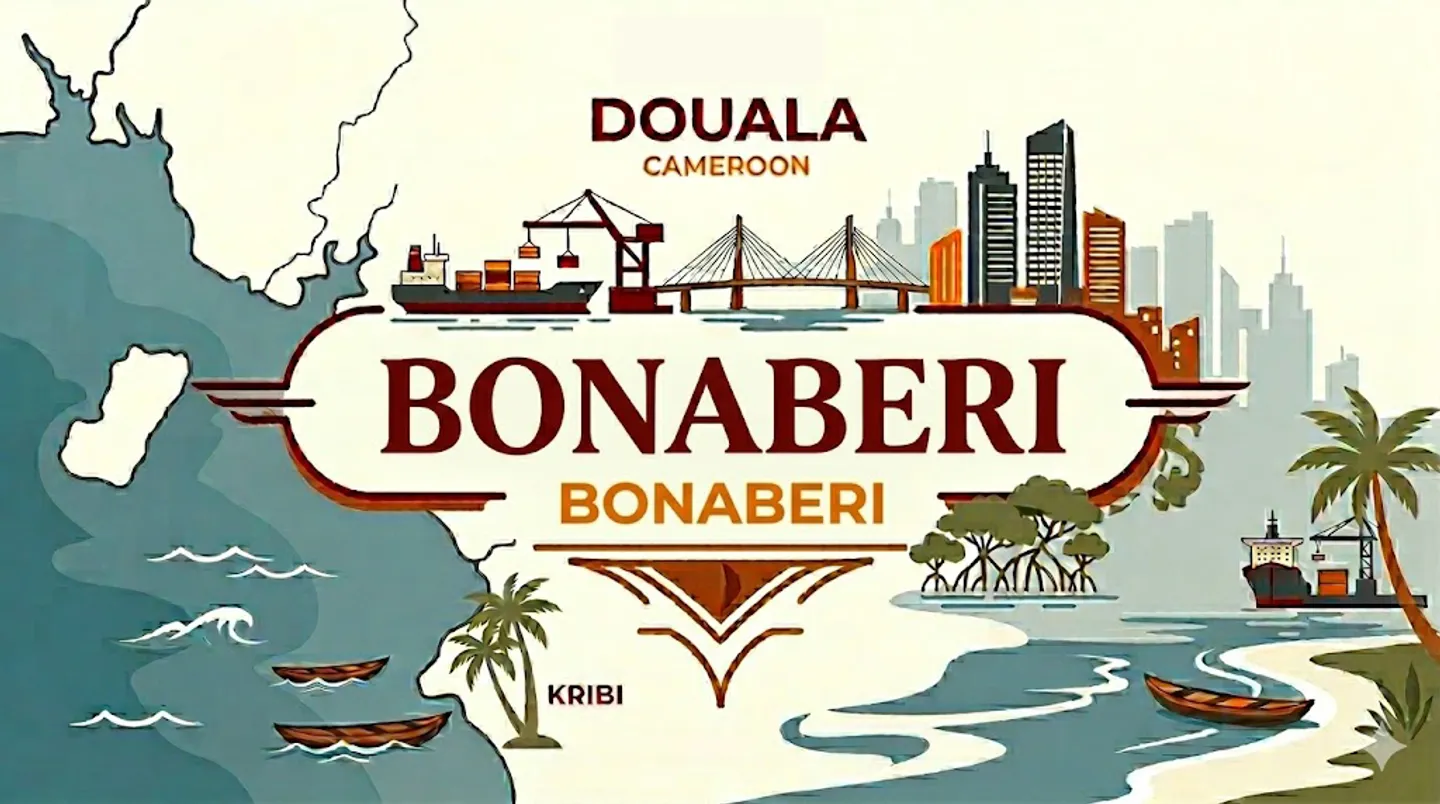
Bonaberi, Douala: The Industrial Bank and Gateway to the West
Bonabéri lies on the right bank of the Wouri, opposite central Douala, in the Douala IV district. Two bridges link it to the rest of the city. It is at once a large industrial area, a group of working-class residential neighbourhoods and the starting point of the roads to Limbe, Buea and the western regions. For a traveller, it is a convenient place to sleep before hitting the road, or to work near the industrial zones.
The Wouri bridges and the traffic jams
For decades, a single bridge linked Bonabéri to the left bank, hence the famous Wouri bridge traffic jams. A second bridge has eased the crossing, but traffic is still very heavy at rush hour: towards the centre in the morning and the other way in the evening. Cross around midday if you can, and leave extra time if you have a flight, a coach or a meeting on the other side.
A history of resistance: the Bele-Bele canton
Bonabéri is one of the city's major Duala cantons. Its chief at the time, Kum'a Mbape, better known as Lock Priso, refused in 1884 to sign the treaty that placed Douala under German protection. The tangué of his royal canoe, a carved prow, was taken to Germany during colonial rule, and its return has been demanded for years. This history makes Bonabéri a place of memory for the whole region.
Industry and residential neighbourhoods
Industries set up in Bonabéri on land that was cheap at the time, and a working-class population settled around them. Today the district is mixed: industrial zones, markets, schools and lively residential neighbourhoods. Its position on the road to the English-speaking South-West makes it one of the districts of Douala where you hear the most English.
Finding your way and getting around
The district includes several areas, among them Bonassama, Sodiko, Bojongo, Mabanda, Ndobo and Bonendale. As elsewhere in Douala, people find their way by landmarks: the name of the area, a junction, a market or a well-known building, rather than a street and number. Taxis and motorbike taxis connect it to the centre over the bridges. For Limbe, Buea or the West, ask your coach company: boarding on the right bank saves crossing the Wouri with your luggage at rush hour.
Where to stay
Rents are generally more affordable than on the left bank. Options range from furnished rooms to flats, often in recent residences. Bonabéri is a good choice if you leave early for Limbe, Buea or the West, or if you work in the industrial zones; less so if you have meetings in the city centre every day. Ask whether the accommodation has a generator and a water tank.
Where to eat
Maquis, grill houses and small restaurants serve grilled fish, soya and Cameroonian dishes at low prices, especially along the main roads and around the markets.
FAQs
Showing 4 of 4 FAQs
What are the challenges of living in the district?
Mainly crossing the Wouri at rush hour, which can take a long time despite the second bridge. The rest of the time, the district offers all the basic services.
Is it an industrial district?
Only partly: the industrial zones sit alongside lively working-class residential neighbourhoods, with markets, schools and shops.
Why is so much English spoken in Bonabéri?
Because the district is on the road to the South-West, an English-speaking region: many residents and travellers come from Limbe, Buea or Kumba.
Should I stay in Bonabéri or in central Douala?
On the right bank if you are taking the road to the West or the South-West, or if you work locally; in the centre (Akwa, Bonapriso, Bonanjo) if your meetings are on the left bank.